
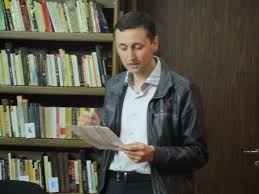
Ivan Pilchin (photo) and Moldova State University: „The Book of Whispers, as a literary way of understanding Armenian genocide
“THE BOOK OF WHISPERS” BY VARUJAN VOSGANIAN AS A LITERARY WAY OF UNDERSTANDING ARMENIAN GENOCIDE
Ivan PILCHIN
Department of World and Comparative Literature, Moldova State University, Chișinău, Moldova
Abstract: The well-known novel “The Book of Whispers” (2009) by Varujan Vosganian is a relevant example of how different cultures, religions and traditions interact in different historical and geographical contexts. The presentation will refer to the way of combining in the novel the historical reality and literary fiction in order to highlight the tragic faith of the Armenian people in its interaction with the neighbor nations during the 20th century. The novel will be analyzed from the perspective of the intercultural theory and culture memory concepts and is attached to the 100 years anniversary of the Armenian Genocide. A particular point in the presentation will represent my own experience of translation of the novel in Russian language.
Keywords: Armenian Genocide, culture and historical memory, literary fiction, intercultural communication, xenophobia
1. INTRODUCTION
The international commemoration of the tragic anniversary of the Armenian genocide centenary in April 2015 raised numerous polemics in mass- media regarding the historical essence and the political consequences of the event. While Pope Francis marked the Armenian genocide as the “first genocide of the 20th century”, the Turkish officials consecutively denied every statement that would entail the necessity of public acknow- ledgement of the historical guilt or any reparations to the Armenian people. The requirement of the recognition of the Armenian genocide as a histo- rical fact on the one hand and the persistent negation of it on the other hand is one of the causes of the continuing cold relations between Turkey and Armenia. The position of the Pope Francis expressed during a mess on the 100th anniversary of Armenian mass killings in Ottoman Empire is obvious in his words that “concealing or denying evil is like allowing a wound to keep bleeding without bandaging it” (ArmenPress, 2015). The worldwide Armenian Diaspora settled for almost a century out of its historical fatherland and almost completely represented by direct descendants of the genocide victims perceived these words as an extra step to the historical equity and hope that it could become a lesson for the future, especially because of the fact that the suppression and denying of the Armenian genocide at the beginning of the 20th century entailed lately Holocaust, Stalinist repressions and other crimes of this type:
All the methods used to kill the Armenians, on the roads of Anatolia, from Constantinople to Deir-ez- Zor and Mosul, were later used by the Nazis against the Jews, methods that ranged from caravans taken to isolated and easily encircled places to be slaughtered, to the concentration camps where the dying were shot, starved, plunged in icy water or burnt alive (V. Vosganian, “The Book of Whispers”, here and further translation from Romanian by Alistair Ian Blyth, 2009:356).
The artistic reception of the events that took place in 1915 began almost at once after the publication of the official documents, photos or memories of those who survived the slaughters or deportations. The very first remarkable appearance in this sense was the autobiographical book “Ravished Armenia” (1918) by Aurora Mardiganian (1901-1994) that was filmed in 1919 by Oscar Apfel (1878-1938) as the “Auction of Souls”. A number of other fiction and documentary films appeared basically after the World War II. The best known literary work on the Armenian Genocide is the historical novel “The Forty Days of Musa Dagh” (1933/2012) by the Austrian- Bohemian writer Franz Werfel (1890-1945) that described the resistance of Armenians on the Musa Dagh Mountain during the Armenian genocide. Among others who wrote about it were William Saroyan (1908-1981) in his short story “The Armenian and the Armenian” (1936), Kurt Vonnegut (1922-2007) in “Bluebeard” (1987), other British, German, Armenian, Polish, Azerbaijani and even Turkish writers.
299
Ivan PILCHIN
2. “THE BOOK OF WHISPERS” AND THE ARMENIAN GENOCIDE
“The Book of Whispers” (2009) by Varujan Vosganian (born in 1958), a Romanian writer of Armenian origin, continues this list of works dealing with the recollection and understanding of the Armenian genocide. Chapters seven and eight of his novel were read during the Worldwide Reading commemorating the centenary of the Armenian Genocide organized on April 21 by the International Literature Festival Berlin and the Lepsiushaus Potsdam. Moreover, being translated in 20 languages the fragments of the book were read in different cities of the world during the commemorative events. Mosaic, multidimensional novel “The Book of Whispers” by V. Vosganian offers the readers a historical and at the same time a very personal perspective to the identity and the tragic destiny of the Armenian people from the 20th century. The interweaving of characters, voices, images, documentary dates, individual memories and evidences make the novel a great epic texture build on the correlation between life and death, past and present, time and space, rational and mystical, divine and human. The historical reality and literary fiction in the book are fused together, although as the author said
every line of the novel is confirmed by documents. I didn’t change the realities in order to produce the stronger influence to the reader. The reality is so terrible and ruthless that is no sense to exaggerate. (Захарян, 2015)
Of all these real-life characters, some of their names you will find in the history books, others you will find only in The Book of Whispers. Although more often than not it tells of the past, it is not a history book, for the history books tell of the victors. Rather, it is a collection of psalms; it tells of the vanquished. (Vosganian, 2009:331-332)
“The Book of Whispers” is a family novel and a book of memory: first of the narrator, then of what “whispered” his forefathers, reconstituting from separate fragments the total perspective on the collective fortune of his family and nation. According to V. Vosganian
telling about it became for me a necessity and a duty, because there are cases that the world wouldn’t know about without this book. (Захарян, 2015)
Thus the novel suggests how the Armenian people as a small nation were forced to survive
300
during the ideological or geopolitical pressures between some great states: between Russian and Ottoman Empires at the beginning of the century, Stalinist and German Nazis troops in the middle of the century, between western liberal views and communist dogma after the World War II.
The novel by V. Vosganian is a relevant example of how different cultures, religions and traditions interact in different historical and geographical contexts. First, the genocide revealed the relation between host and foreign nations at a certain territory: that of the public domination and submission; however the relations on the simple human level are often characterized as being cooperative. Armenian people during the genocide were placed in the position of civilly dead victims against the politics of rage discrimination. Then, after the “Exodus” the interethnic and intercultural relations of Armenian Diaspora with other places and people highlighted their often outside status, that of the “xenos”, that brings them together with the nations that experienced the same destiny – Jews and Gypsies. The otherness and xenophobia attitude to Armenians in Romania of the past is relevant through the image of the narrator’s grandfather:
Under the Iron Guard regime he was slapped around, accused of being a Jew, and only the crucifix he wore at his throat saved him from much worse. He was slapped around after the communists came to power, accused of being a member of the Iron Guard, but this time the crucifix he wore at his chest was of no use to him, quite the contrary. (Vosganian, 2009:322)
The state of lack of freedom wherever they are continues in a kind of hostage that involves this time not only the Armenians but also the Romanians as their neighbors and host nation during the expansion of communism after the World War II. Thus, speaking about the Russian soldiers coming and leaving Romania, one of the characters says that “If we are to be free, then rather than them leaving and us remaining, we should leave and they should remain”, because
the red flags had sunk roots and the hammers and sickles had become part of the plasterwork, so that to remove them from the frontons you would have had to rip away the wall. (Vosganian, 2009:326)
The “Nansen” or stateless status of Armenians in Romania shaped their new identity of people whose “fatherland is everywhere and nowhere”, of “nobody’s” people, a nomad, straying nation in a perpetual search for home:
“THE BOOK OF WHISPERS” BY VARUJAN VOSGANIAN AS A LITERARY WAY OF UNDERSTANDING ARMENIAN GENOCIDE
We became the Romanian citizenship in 1948, as I found in the documents of my grandfather Garabet. Before that we weren’t taken in the army, we couldn’t launch a business in our name, we could only go everywhere we wished, although nobody else welcomed us. We were Nansenians. (Vosganian, 2009:55)
However the most part of Armenians went to America, the idea was that “if at one day it will prove that it isn’t a searched land, they will go again to the roads”. Focșani, the narrator’s native town in Romania, became in this sense a new home and place of encountering and reciprocal perception not only for Armenians, but also for many other peoples: Jews, Greeks, Albanians, and Gypsies.
Nevertheless, contrary to deportations, humiliation or persecution Armenians were able to keep their authenticity as ethos. “The Book of Whispers, as we find in the novel, is not a history book, but one of state of conscience”. This becomes evident through the attitudes of characters to what is home, life, death, and above all time and space. Thus, as the narrator:
To the old Armenians of my childhood the place where they lived seemed accidental. To some of them even the time in which they lived seemed accidental, except that time was harder to deceive. (…) As place was therefore nothing but a convention, which you could ignore when the circumstances were not particularly threatening, my old folk were fascinated with wide-open spaces. They used to speak as if they could be in different places at once. This probably helped them to survive when it seemed the hardest thing possible, but it also helped them die when there was not much else to do. (Vosganian, 2009: 321)
The culminant part or the book (chapters Seven and Eight) shows the consequent process of bestial extermination of Armenians from the Eastern territories of the Turkey inside the “seven circles of death” that symbolically mean the mortal deportation or the “initiation in death” of Armenian people:
The dead resulting from the endeavour to annihilate the Armenian people were not as numerous, if comparisons can be made between crimes on such a scale, but they were numberless. The names of which we know are mainly those of the murderers, the governors, the camp commanders, the pashas, those with the ranks of bey, aga, çavuș. The victims rarely have names. (…) From this nameless core of death I have traced seven circles, whose centre is
Deir-ez-Zor. Within their area, whose outer circumference passes through Mamura, Diarbekir and Mosul, more than a million people died, around two thirds of all those who died in the Armenian genocide. We know that they were there and that of those who entered the circles of death, of those who were not forcibly converted to Islam, sold as slaves or taken for the harems, almost none escaped. Anybody could die anywhere. There is not one family of Armenians in this world that does not have a member who vanished in the circles of death, as if dragged down into a whirlpool. Therefore, you can pray at the edge of every mass grave in the sure knowledge that somebody who belonged to your family is laid there. (Vosganian, 2009:356-357)
The collective memory about this was more than a “whisper”: it was merely an inaudible prayer or an interior silence caused by the shock of memory:
My grandfathers, Garabet Vosganian and Setrak Melikian, did not sing songs of the deportation in their moments of solitude. And nor did the other old Armenians of my childhood. The poems we read as children, the songs we heard, told mainly of the fedayi who had fought in the mountains, nor of the massacres and the deportations. In silence did the caravans descend each level of the initiation into death. Perhaps it was because the inner suffering was too strong to allow anything to pierce through to the outside. Perhaps it was because they did not believe that anything would come afterward. (Vosganian, 2009: 352)
The attitude towards death and relation with it is what, after V. Vosganian, defines the interpersonal, interethnic and intercultural relations: “We differ not through what we are, but through the dead people that everybody bewails”. These words, attributed to the grandfather of the author, became the epigraph of the book and the key to it because they determine the dimension of memory, the existential position in front of the other, family roots and sources of the past.
3. CONCLUSIONS
While translating “The Book of Whispers” from Romanian in Russian I had a feeling, however pathetic it may sound, of doing something important not only for the Romanian literature itself, but for the recovery of what shouldn’t be forgotten. The direct certainty of this I took listening to V. Vosganian while presenting his novel in 2010 in Chișinău:
301
Everyone lives in his simplicity an epic. For every life seen careful, with patience and tolerance can be compared – by the intensity of living, by the symbols of the simplest things – with some great epics. It’s a terrible way to understand the world. But beyond that nothing and never will be able to overcome the book. History is an infinite series of victories of the book… Most powerful empires collapsed, the cities fell, the armies were scattered, but what resisted is the memory of the leaf … For the true human memory is the memory of papyrus, manuscript memory, memory of the book. It was a kind of nervous system of humanity… Who remembers today the name of prince of Florence in times of Dante Alighieri?.. The authorities have never won the book, because people write more than they can forget… The great conqueror of world history is the book. The real heroes don’t need to look for under the horses’ hoofs, but in the pages of books. Those who have created history were not the winners, generals, but those who were defeated, the poets. (Notes from my personal archive)
BIBLIOGRAPHY
1. Apfel, O. (1919). Auctions of Souls. [movie]. First National Pictures, Seling Studios for the American Committee for Armenian & Syrian Relief.
2.
3.
4. 5. 6.
7.
8.
Mardiganian, A. [1918] (1990). Ravished Armenia. The Christian Girl Who Survived the Great Massacres. Long Island City, NY: JC & AL Fawcett.
Saroyan, W. (1936). The Armenian & The Armenian. In W. Saroyan, Inhale & Exhale. New York: Random House. 437-438.
Varujan, V. (2009). Cartea șoaptelor. Iași: Polirom.
Vonnegut, K. (1987). Bluebeard. A Novel. New York: Delacorte Press.
Werfel, F. [1933] (2012). The Forty Days of Musa Dagh. Translated by G. Dunlop & J. Reidel. Boston, MA: Verba Mundi.
***. (2015, April 12). Pope Francis on Armenian Genocide: Concealing or Denying Evil is Like Allowing a Wound to Keep Bleeding. [online]. ArmenianPress. Armenian News Agency. Available: http://www. armenpress.am/eng/news/801409/pope-francis- on-armenian-genocide-concealing-or-denying- evil-is-like-allowing-a-wound-to-keep- bleeding [Consulted on 15.04.2015].
Захарян, А. Эхо «Книги шепотов» [online]. Новое Время (Ереван). Available: http:// www.nv.am/news/ 23836-2012-11-24-07-35- 48 [Consulted on 05.05.2015].
http://www.afahc.ro/ro/rcic/2015/rcic’15/IEL/Pilchin%20I.pdf
